Most first-time developers in Melbourne focus entirely on the planning permit. They worry about setbacks, garden areas, and neighbourhood character. While these are necessary hurdles, the legal structure of your subdivision is often where the profit is made or lost. Specifically: will your plan of subdivision include common property (and therefore an owners corporation), or will each lot stand entirely independent?
The choice between these two structures dictates your construction costs, your infrastructure obligations, and ultimately, the market value of the finished product. We see many developers realise too late that their site configuration forces them into a subdivision with common property when they promised their bank lots free of an owners corporation, or vice versa.
Here is the pragmatic breakdown of how these structures work under the Victorian Subdivision Act 1988 and how to choose the right one for your project.
Subdivision Without Common Property (Independent Lots)
When you create a plan of subdivision without common property, you create fully independent lots. Each owner owns the land and the building on it outright. There is no shared driveway, no shared garden, and no owners corporation. Each lot must connect directly to public services: water, sewerage, electricity, and drainage.
All titles produced through this process are registered under the Torrens system at Land Use Victoria, the same registration system that underpins virtually all freehold land in the state.
When to Use Independent Lots
We typically advise clients to pursue a subdivision without common property for:
- Corner Blocks: If you are splitting a corner block in suburbs like Bentleigh or Glen Waverley, where each new dwelling can face a different street, independent lots are the logical choice.
- Side-by-Side Dual Occupancies: If the frontage is wide enough (usually 15 metres or more) to allow two separate crossovers and driveways.
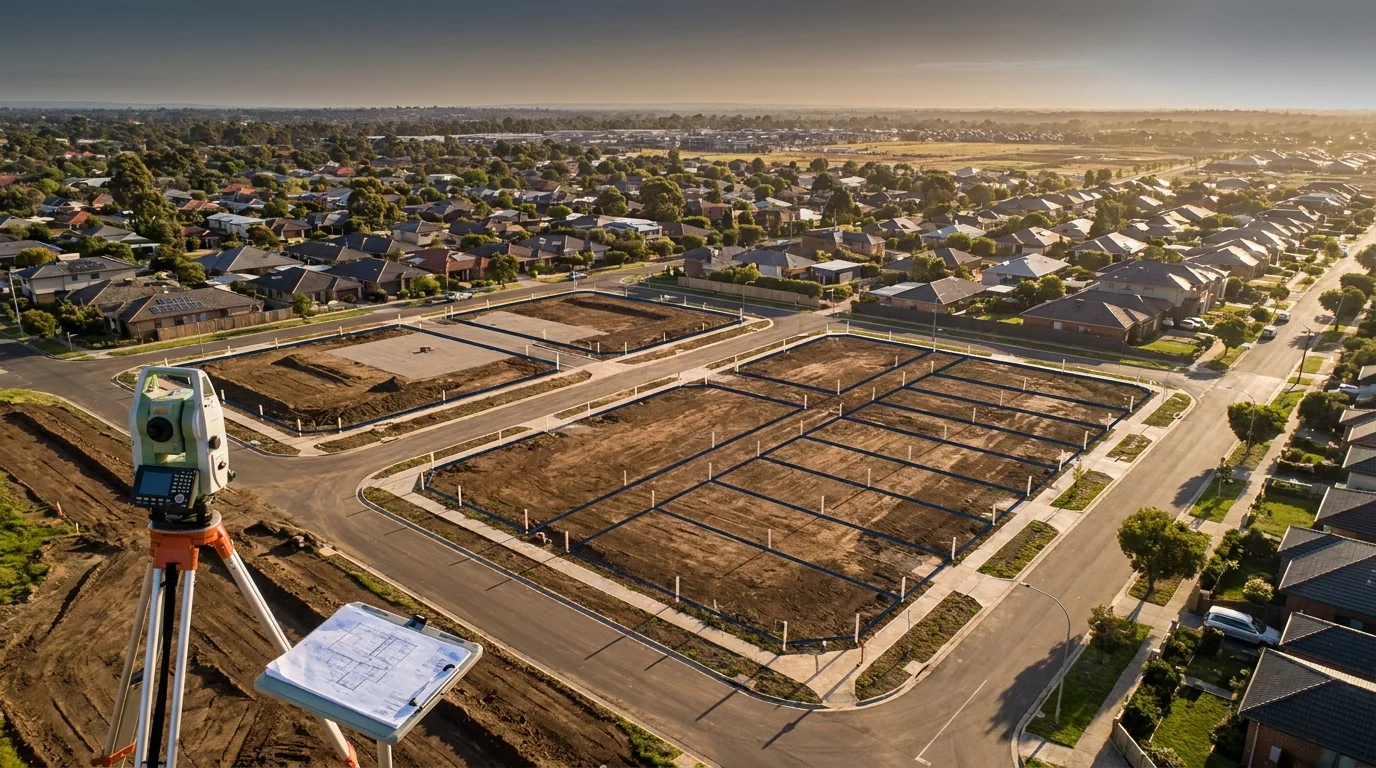
- Greenfield Estates: Large scale land developments almost always produce independent lots for the individual house sites.
The Financial Implications
Properties free of an owners corporation generally command a higher resale price. Buyers prefer the independence of owning their own land without a committee governing maintenance obligations or shared costs. There are no quarterly owners corporation fees, which is a strong selling point.
However, the infrastructure costs are higher. You cannot run a shared sewer line or a single water tapping for multiple dwellings. Each lot needs its own connection to the relevant authority assets. You also lose land to driveways. Because you cannot have a shared carriageway, each dwelling needs its own access, which eats into your developable area.
The absence of an owners corporation also simplifies financing for the end purchaser. Banks and conservative investors favour the certainty and simplicity of a standalone lot.
Subdivision With Common Property (Owners Corporation)
A plan of subdivision that includes common property creates individual lots (the units or townhouses) plus shared areas (driveways, service pits, shared gardens). This is the standard structure for apartments, units, and townhouses that share a single street frontage.
When you register a plan of subdivision with common property, you automatically create an owners corporation under the Owners Corporations Act 2006. This legal entity manages the common property and holds the insurance for those shared areas. All lot owners are members of this corporation.
When Common Property Is Required
A subdivision with common property is often the only option for:
- Battle-axe Blocks: If you are keeping the front house and building in the backyard, the new rear lot usually shares the driveway with the front lot.
- Multi-unit Developments: Three or four townhouses on a standard suburban block will invariably require a shared driveway to access the rear dwellings.
- Apartment Buildings: Vertical subdivisions always require common property and an owners corporation.
The Yield Advantage
Including common property allows you to maximise the yield of a site. By sharing a driveway, you save land that would otherwise be consumed by duplicate access points. This efficiency is why subdivisions with common property dominate medium-density infill areas.
The trade-off for higher density is the ongoing administration of the owners corporation. Research into residential subdivision communities indicates that while density increases, it requires careful management of shared spaces to maintain resident satisfaction.
The Grey Area: Service Infrastructure
The physical location of pipes and cables often dictates whether common property is needed. In a subdivision without common property, services generally cannot run through a neighbouring lot unless an easement is created on the plan of subdivision. Easements can be messy and devalue the burdened land.
In a subdivision with common property, services can run through the common areas without the need for separate easements, because all lot owners hold a collective interest in that land. If your site has a single sewer connection point at the rear corner and you want to build three units, common property simplifies the drainage design significantly. The plan of subdivision can also create formal easements where services cross between private lots.
The Registration Process
Regardless of whether the plan includes common property, the process to register new titles follows the same path through council and Land Use Victoria. We handle this via SPEAR (Surveying and Planning through Electronic Applications and Referrals).
- Planning Permit: You obtain approval for the development and the subdivision.
- Certification: The council certifies that the plan of subdivision matches the permit conditions.
- Statement of Compliance: Issued once all physical works (drainage, driveways) are complete and authority fees are paid.
- Lodgement: We lodge the plan with Land Use Victoria to register the new titles.
A common delay occurs at the final stage. Your bank must consent to the subdivision before titles can issue. Your SPEAR application lawyer will need to coordinate with your lender early to prevent settlement delays.
Restrictions and Covenants
When creating new titles, you must also consider what restrictions will be placed on them. Councils often require a Section 173 Agreement under the Planning and Environment Act 1987. This is a legal contract between the landowner and the council, registered on the title. It might prevent future subdivision or mandate certain design standards.
Existing restrictions can also block your preferred subdivision structure. We frequently see older titles with "single dwelling" covenants. Victorian courts are discharging restrictive covenants that are obsolete or vague under section 84 of the Property Law Act 1958, but you must identify these early. If a covenant prohibits more than one dwelling, neither subdivision structure will help you until that restriction is removed.
Making the Decision
Your decision should depend on the physical constraints of the land and your target market.
If you are building high-end product for owner-occupiers, a subdivision without common property is worth the extra expense in civil works. The absence of an owners corporation is a distinct marketing advantage. If you are developing investment-grade stock or need to extract maximum yield from a standard block, a subdivision with common property is the pragmatic route.
We recommend engaging a surveyor and a property lawyer before you finalise your design. We can review the site dimensions and the location of services to determine whether a subdivision without common property is physically possible. It is cheaper to adjust a line on a draft plan than to dig up a driveway because the council refused your Statement of Compliance.
This information is general in nature. Contact us for advice specific to your project.